I’ll never forget the day a college freshman came into my office, dropped into the chair across from me, and said, “I know this is stupid, but I need help.”

Her voice cracked on that last word, the way voices do when someone has been holding too much for too long. She pulled her sleeves over her hands, stared at the floor, and whispered, “I don’t know how to email my professor.”
For a moment I thought she meant she didn’t know what to say to her professor. But no, she meant she didn’t know how to begin. How to greet them. How formal or informal she was allowed to be. How to explain she’d fallen behind because everything suddenly felt heavier than she expected. How to ask if she could make up an assignment she was too embarrassed to talk about.
This wasn’t about an email. It was about fear. It was about the moment she realized she was on her own without an adult to guide every step. She was, for the first time, staring down a problem she had to solve herself. And that, right there, is the thing parents don’t see coming.
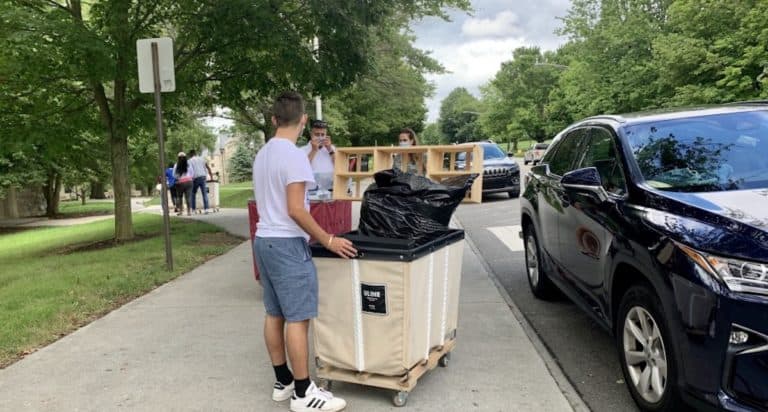
We pack our kids’ cars with shower caddies, ramen noodles, dorm-sized tool sets, and all the “college essentials.” What we don’t always think about are the invisible skills that, for many teens, matter more than any item they bring with them.
The invisible skills that matter more than any item teens bring to college with them
1. The skill of asking for help without shame
Through her tears and our conversation, we realized what she needed wasn’t a lesson in email etiquette. What she needed was permission to be human. Somewhere along the way, she had learned that asking questions meant she was “behind.”
That asking for help meant something was wrong with her. And in her fear and insecurity, she waited. And waited. She waited so long that she now felt stupid for even thinking about emailing him because it was so late. In her fear and shut down, something so simple became a mountain she didn’t know how to climb.
What teens need isn’t perfection. It’s the ability to say, “I’m confused,” long before panic sets in. And yes, parents can help create that culture at home, not by doing everything for their teen, but by being the safe place where confusion isn’t treated as failure.
2. The skill of recovering from a setback
A few weeks after the email incident, a different student sat in the same chair and told me he’d made a 63 on his first college exam. He looked genuinely shaken.
“I’ve never failed anything,” he said quietly. “Am I not cut out for college?” He wasn’t being dramatic.
This was the first time life had bumped up against him in a way he couldn’t immediately fix. In high school, he rarely had problems, and when he did, he could outrun them with ease. College had a different pace. A bigger landscape. More spaces where he couldn’t hide.
Teens don’t need a perfect academic record to succeed, but most of them don’t know that. They often don’t know that one bad grade is not a prophetic indication of their capability. They don’t need to ace every test; they need practice getting back up. They need to hear that struggle is a part of growing. It’s not a sign that they don’t belong.
3. The skill of building their own structure amidst a sea of newfound freedom
One student once showed me her planner. It had three class times written in neat blue ink and absolutely nothing else. “I’ll just fit everything in around these,” she said. Three weeks later, she was overwhelmed, exhausted, and eating dry cereal at 10 p.m. because she’d forgotten dinner even existed.
High school gives teens a rigid structure they don’t realize they’re using. They have parents, teachers, coaches, and bosses telling them when to wake up, when to arrive, what to do, and when to get it done.
Then it disappears. Overnight.
We, the adults, have inadvertently micromanaged their schedules for them and, unfortunately, have rarely helped them practice creating their own rhythms. But here’s the kicker: it doesn’t have to look like a completely filled schedule from sunup to sundown. All they really need are some anchors or regular practices. Things like going to bed at the same time, working out in the mornings, or simply eating at regular intervals.
Adulthood is one long stretch of time no one organizes for you. The earlier they learn how to give shape to the week, the steadier they feel.
4. The skill of navigating relationships without avoidance
One student went an entire week without speaking to his roommate because the roommate borrowed his charger without asking. He tiptoed around his own dorm room, waiting for the “perfect” moment to bring it up.
“There is no perfect moment,” I told him gently. “There’s just a moment you decide to be Human.” Teens today are wildly connected online and unfathomably uncertain in person. They know how to text, but they rarely know how to say, “Hey, can we talk about something?”
But those tiny moments of honesty are the glue of adult relationships. Roommates. Professors. Friends. Employers. Partners. Life is full of conversations we’d rather avoid. Teens don’t need to master conflict. They just need to trust that awkwardness doesn’t always mean something is wrong.
5. The skill of managing overwhelm when their brain wants to shut down
One of my college clients recently told me, “When I feel overwhelmed, I shut down. I can’t think. I can’t move. I just stare at the ceiling.” Like so many others, he thought this made him “bad at life.” He thought there was something inherently wrong with him that others don’t have to deal with.
I told him that what it made him was a young adult who was struggling with what to do with big feelings and a lot of responsibilities. For him, parents and teachers had always taken the pressure off before he ever reached his emotional limit.
But College doesn’t do that. Adulthood definitely doesn’t.
For students like him, what helps isn’t telling them to “try harder.” It’s teaching them the tiny resets that calm the nervous system and help them take the next step. It’s things like a five-minute walk, a deep breath, a willingness to just do the first thing instead of tackling the whole mountain.
What I wish every parent knew
Most teens aren’t truly lacking life skills. They’re lacking experience. Experience with responsibility combined with independence. And experience with the emotional and mental side of adulthood.
They don’t need to leave home fully ready. They can’t.
All they need is enough:
Enough courage to ask for help. Enough resilience to recover from setbacks. Enough structure to keep the week from collapsing. Enough communication to keep relationships healthy. Enough coping skills to stay afloat when everything feels heavy.
You can’t teach them every skill they’ll ever need. No one can.
More Great Reading: