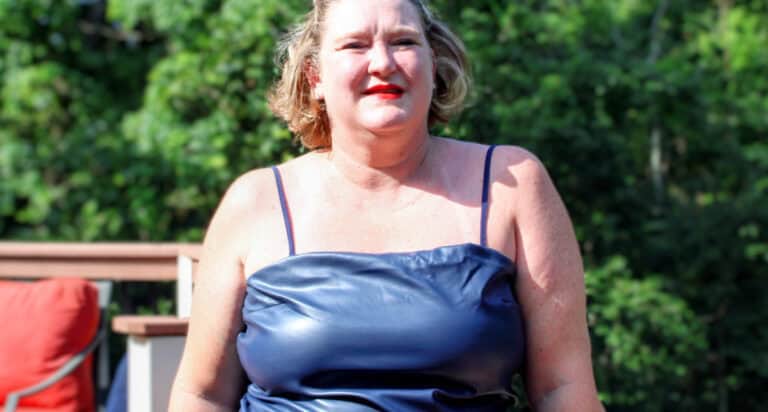
On an ordinary Monday evening this past June, after hanging my new bird feeder and chatting with me over dinner about nothing in particular, my husband died suddenly. We had been empty nesters for almost two years and grandparents for a year.

We were at the beginning of a new phase in our nearly 33-year marriage. And we were loving it. We had big plans and much to look forward to. Now, I’m trying to figure out how to navigate a life that looks much different from the one I thought we’d have.
Of course, I’m not the first person to grieve the loss of a husband relatively early in life. I’ve heard from and about many women who have been widowed in their 40s and 50s, and while there’s no “good” time to lose a spouse, and everyone’s experience is different, I think there are some unique aspects of being an empty-nest widow.
7 unique aspects of being a widow in an empty nest
There are likely a lot of years to go
I’ve done the math (it’s actually called widow’s math), and it’s heartbreaking. If I live to be as old as my grandmother, I will live more years without my husband than with him. Obviously, this is true for women who are widowed in their 20s and 30s, but empty-nest widows are facing those first years alone in an empty house.
“Broken Heart Syndrome” is real
Since losing my husband, there have been times when I have worried that the tightness in my chest was more than just the ache of missing him. Then I learned about broken heart syndrome. As it turns out, extreme emotional stress, like that brought on by the loss of a loved one, can cause a person to have heart attack-like symptoms that, in some cases, can even warrant a visit to the ER. Considering 1 in 5 people who die of a heart attack is under 64, those symptoms can be especially scary for those of us in middle age.
Staying busy helps
Obviously, as an empty-nester, I live alone. Since my husband’s death, I’ve been fortunate to have friends who regularly invite me to do things. Because staying home alone too much is a recipe for depression and because decision-making is difficult right now, my policy has been to say yes to every invitation–whether I feel like it or not. This strategy is proving helpful for now.
There are different grieving styles
Intuitive grievers experience grief primarily through emotions. They are more likely to express their grief openly and process their grief by verbalizing and working through their feelings. Instrumental grievers tend to be more cognitive and task-oriented in their grief. They also feel deep sadness, but they are more inward in their grief and might focus on things like ways to adapt to their new normal or ways to memorialize or honor their loved one. Often, people are a blend of these two styles.
Grief styles are universal, regardless of one’s stage in life, but because of the isolating nature of grief as an empty nester, it’s helpful to recognize that there’s no right or wrong way to grieve.
Grief doesn’t always feel like grief

The deep sadness I’m experiencing at the loss of my husband feels natural–almost like proof of the enormity of my loss. But the anxiety that accompanies it has been a surprise. In his book, A Grief Observed, C.S. Lewis writes,
No one ever told me that grief felt so like fear. I am not afraid, but the sensation is like being afraid. The same fluttering in the stomach, the same restlessness…
C.S. Lewis
There’s a physical sense of unease that comes with grief, and this can be particularly hard to navigate in an empty nest–without the distraction of a house full of children and all their activities. I’ve found it helpful just knowing that anxiety is a normal manifestation of grief.
Grief can co-exist alongside joy
Our three grandsons are all under two years old. These babies are an absolute delight, bringing laughter and joy into my life every day. Not being able to share the joy of them alongside my husband is painful, but there is joy nonetheless. In fact, spending time with our children and grandchildren is a beautiful, bittersweet reminder of the life we created together.
I’m seeing the fruits of my husband’s parenting
In the months since my husband’s death, our children (who are all adults) have been there for me in a thousand ways– both emotional and practical. They check in with me, spend time with me, help with fix-it jobs around the house, and see to various details that I simply don’t feel equipped to handle right now. My children learned about compassion and hard work from their dad. They are their father’s children, and I’m grateful to see them living by his example.
Being widowed in midlife isn’t more painful than it is for people who are younger or older, but it does add a layer to grief that it’s helpful to acknowledge. It’s profoundly disorienting to be a widowed empty nester. I find that some days, I feel so unmoored that it’s hard to get my bearings.
And yet, life goes on. How can it not? My husband devoted his life to me and to our family. I try to honor him every day by being grateful for the wonderful life we created and that continues in our children and grandchildren.
More Great Reading: