Man, it’s tough to keep those connections intact once they’re out of the house. It seems to get harder the older and more independent they become, especially if they live far away. Is it just the phase we’re in, maybe?
After we become grandparents, will they reach out so often we start screening their calls? I sure hope we have that problem someday. Because right now, I miss my grown kids. I’m always on the lookout for excuses to contact them.
The philosophical group chat
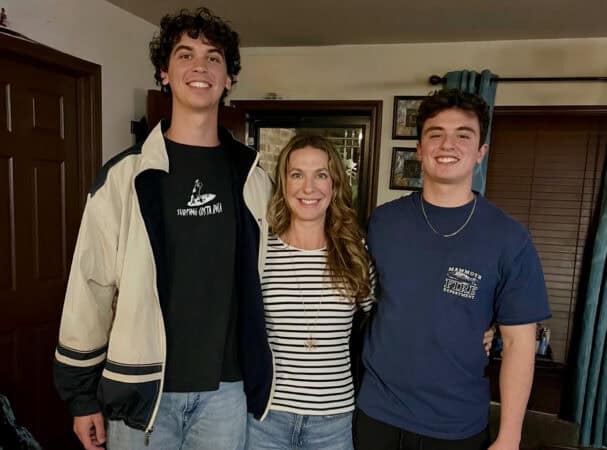
About eight months ago, I decided to try something new with my grown sons, 26 and 21. Without any preface or explanation, I started posing philosophical(ish) questions in a group text.
It was an experiment at first, to see if and how they’d respond. My ulterior motive was just to hear from them more frequently, but the result was so much more than that. Their responses have given me a peek into how they reason, how their worldviews are evolving, and how their thinking overlaps and differs from each other.
Turns out, both my kids are “low-key terrified of AI” and both are really into Stoicism. They have substantially different spiritual perspectives and their politics are starting to shift in different directions, yet they have similar principles about dating and marriage.
While our group texts went pretty deep at times, some weeks the chat was so funny I had mascara running down my cheeks at work. The conversations took a dark turn here and there, too, which is to be expected from two young men with a cynical sense of humor and an irreverent streak they inherited from their Gen X parents. But more often than I expected, my kids’ responses were genuinely thoughtful. At times, they were so heartwarming they made all those old parenthood worries about screwing them up seem like such a foolish waste of energy.
Actual questions posed, so far
Here’s a list of 27 actual questions from our weekly group text. Some were more provocative than others, but many of the seemingly banal questions sparked interesting discussions.
Admittedly, a few questions were based on my efforts to guide them toward a certain conclusion, while some I simply asked for shock value. Gotta keep ‘em on their toes. One or two are questions the boys threw out for debate.
- Are people naturally good, or do we need external influences (laws, norms, traditions) to become good?
- If you could make one decision today that would positively impact your grand children, what would it be?*
- They say if you look up at the sky for 2 straight minutes, it’ll change your life. Thoughts?
- Are we fundamentally: a) human beings capable of having spiritual experiences or b) spiritual beings having a human experience?*
- What’s one thing your parents did/said that you’ll 100% repeat with your own kids? One thing that you 100% will NOT repeat with your own kids?*
- Reputation vs character: Which one matters more? Why?
- What is the difference between wise and smart?
- True or false: The net benefits of alcohol outweigh the net damages—not the legality of alcohol, but the use of it. Basically, is a society better off with alcohol or without it? Explain.*
- Are good and evil real entities—or human inventions?*
- Confidence vs arrogance: What’s the difference?
- Does wisdom have anything to do with how you share knowledge with others?
- With my 46th bday approaching, I’m curious… What do you see your life looking like when you’re 46? What does success look like at that age? (Not fishing, btw. Genuinely curious about each of your thoughts on your own future selves.)
- Did you know suit etiquette says never button the bottom button on your jacket?
- Why does our society tend to celebrate life choices that many people later regret but overlook the ones that tend to produce the most fulfillment?
- I just learned this: Some countries prohibit foreign ownership of land, but their citizens and companies are allowed to own land in the U.S. Thoughts?*
- Is personal growth about becoming someone new, or about stripping away expectations until who you really are and what you show the world match?
- I read something: Before you make a purchase, ask, “Does this actually improve my life… or just how my life looks to other people?” How many purchases, if we’re being honest, fall into the latter category? And bigger question—does it matter?
- Doing the right thing often means being misunderstood. So how do you build the courage—and the thick skin—to do it anyway, regardless of others’ opinions?*
- Long-term surveys show American women’s happiness has decreased since the 1970s. Why do you think this is? What should men do with this knowledge?*
- I stared at you when you were babies. To this day, my advice to new moms is to just make time to sit and stare at the wonder of their newborns at least once every day. No question this week—just wanted you to know.
- What traits do you feel you’ve chosen, versus inherited or adapted? Example: I distinctly remember deciding not to be shy anymore in elementary school.*
- The truth always comes out in the end: True or false? Elaborate.
- If you could pinpoint one major mistake in your life so far and then, poof, erase it—would you? Why or why not?
- What’s a decision that seemed small at the time but wound up being life-changing?*
- Our rights come from government—true or false?
- We’ve created a society where being seen doing the thing is more important than doing the thing. Agree or disagree?*
- Should elected officials vote their conscience or their constituency? If they have a change of heart once they get into office, are they obligated to still vote what the majority of their constituents want, or obligated to vote what they believe is best?*
The starred ones are those that elicited the most vibrant responses, in case you want to borrow from this list. Before you dive in with your own philosophical group chat, here are a few recommendations.
A few tips for keeping ideas flowing
Before sending the first question, I set myself some ground rules. Here are the ones that have worked well, along with a few I’ve learned along the way.
Start just between us—me and the kids
It’s not about excluding anyone, but creating a safe zone for my kids to freely wrestle with ideas in the gray area. I want them to feel like they can express whatever opinions they want, even ones that are controversial or that aren’t fully fleshed out. It’s easier to do this when the only audience member is wearing mom goggles.
Be ready for anything
Before I send the weekly question, I sometimes have to steel myself for the possible responses, knowing they might shock or even dishearten me. And I have to remind myself that it’s okay. Nothing is set in stone. I thought about the world much differently in my 20s than I do now.
It’s not a lecture, but an exchange
If it’s a fun, heated debate, then I’ll get on my soapbox and defend my position. But if someone expresses an opinion that I fundamentally disagree with and the tone is not playful, then keeping my mouth shut (thumbs still) is often best. Also…
Vague reactions are okay
“Hmmm,” and “Interesting,” and “Ah, I think I see what you mean,” are some of my faves. They don’t shut down the discussion or stifle input. But they also don’t convey that I agree with something I think is totally misguided. I also like, “I can tell you’ve thought about this a lot,” or “Seems you feel strongly about this one.”
Stay curious with follow-up questions.
My children are adults now. They have life experiences different from mine and, contrary to stereotype, haven’t arrived at all of their positions through TikTok. They often have very valid, well-researched viewpoints.
When I’m able to replace a rebuttal with genuine curiosity, asking open-ended follow-up questions, it bridges the philosophical gap between us. When I’m able to pull it off, staying curious usually eases my concerns too. It’s nice to see the wheels turning as they think it through a little further or when they make a compelling point that opens my eyes.
Don’t correct their mistakes
This is not the time, even when I know I’m being baited. Example: My sons insist on putting the dollar sign after the number (100$) just to irk me. They know better—one was a finance major for goodness’ sake. If I start correcting this or the occasional misuse of a word, however, it’ll change the tone and derail the chat. So I remind myself: no proofreading notes allowed.
Wait
They don’t always respond immediately. That doesn’t mean they’re not interested. When we were all on vacation together a few months ago, both sons told me they really enjoy the weekly questions but sometimes it takes a while to respond. They’re either busy or genuinely mulling over their responses. One of my sons even said the questions have been a hit in the lunchroom at work. Sometimes he delays his response until after he’s debated the topic with his coworkers.
Give it a try
Eight months in, I can’t say whether this qualifies as meaningful philosophical debate or just an elaborate scheme to get my sons to text me more often. Either way, it’s working. Give it a try with your grown kids. If nothing else, it’ll show them you’re ready and willing to connect whenever they are.
More Great Reading: