Fun hike. Dislocated my knee. Popped back in. All good.
That was the text. Four sentences, casual as a note about the weather, from my son on a mountain a few hours from campus. My first reaction was panic. My second was disbelief that anyone could describe that sentence as “All good.”
Every parent I know struggles with the same moment at drop-off. The drive home, the empty room, the question of how much to still hold on. We’re told to let go, and we nod, and then so many of us spend the next four years white-knuckling it anyway, one eye on the phone, ready to swoop in.
I was no different, but this is the story I now tell friends whose teens are headed off this fall. It’s the one where I actually let go, fully, and watched what happened when I did.
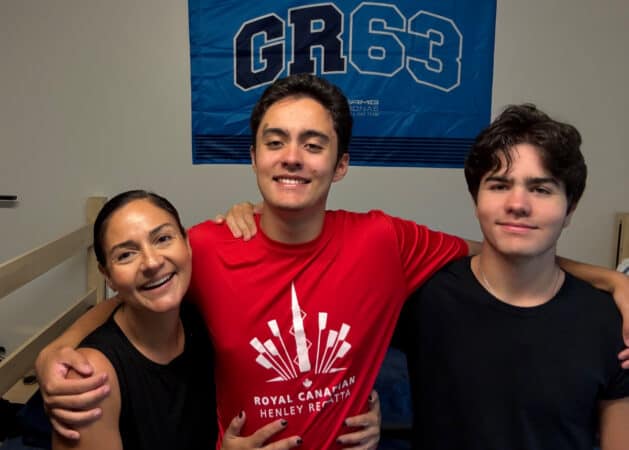
My son was hiking with his friends when this happened
He was hiking with his crew team, a hard climb, but they’re all athletes, so it didn’t worry me. I sent him a note as he was wrapping up to ask how it went. That’s when I got the text. I called immediately. He’d stepped on a wobbling rock, felt his knee pop out, took a few panicked steps, and somehow it popped back in. Hikers behind him happened to have a knee brace.
He strapped it on and kept climbing, because the summit was the only way to reach an emergency pickup point, then made the long walk back down. His crew mates waited for him the whole way, patiently, secretly relieved they didn’t have to call a medical helicopter.
Every motherly instinct told me to go to him
That phone call was terrifying. Every instinct said, “Get in the car. Your baby is hurt. Go fix this!”
But I didn’t go. I thought about it, standing in my kitchen, but I kept coming back to the same thing I’d told myself at drop-off freshman year. He’s not mine to manage anymore, he’s mine to support. Those are different jobs, and I’d spent eighteen years doing the first one.
This was my chance to actually practice the second. The next day, over the phone, we talked through the next steps, and he found his own urgent care and went in. They recommended an appointment with an orthopedist and let him know he would likely need an MRI to rule out a tear. He was about to come home for Thanksgiving, so I gave him my radiologist’s number and had him schedule it himself. He then found the orthopedist on his own, in-network, walking distance from campus.
In addition to all the logistics, he also had to regulate his emotions and handle the uncertainty of the injury while he waited on results. When would he recover? Would he be out for the season? For all of college?
My son took care of everything related to his recovery
Thankfully, he’d been lucky and nothing torn. The orthopedist called it his “one freebie,” the next time, surgery. He prescribed two months of physical therapy, and let him know it was good he was a rower. This would have ended a soccer or football career.
Relieved and motivated, my son found his own physical therapist and coordinated everything himself. Appointments, insurance, transportation, the location of every recumbent bike on campus, all of it, week after week, for two months before he was even cleared to touch a rowing machine.
Home for winter break, he found a new PT in our hometown and again handled the insurance on his own. Back at school, he finished therapy and got cleared to rejoin the team.
A month later, he texted me one short phrase. “I PR-ed!” With a smile, I knew that meant he crushed 2000 meters on the rowing machine, but more importantly, he was now officially and fully recovered.
Resisting the urge to jump in was really hard
I’ll be honest and say that resisting the urge to call the orthopedist myself, or drive down and manage things in person, felt like failing him. It felt like the opposite of what a good parent does when their kid is hurt. But I don’t think anything else could have given him what that recovery gave him.
Knowing his teammates had his back on the mountain gave him security and confidence. He knew he had chosen his “people” at school wisely. Navigating doctors, insurance, and scheduling on his own appointments while managing school gave him a competence he hadn’t had to earn before. And managing his emotions while rebuilding his own body, knowing that anything other than strict adherence to the PTs instructions would cost him his college crew career, gave him ownership and accountability. Not just of his knee, but of his life.
That’s exactly why I think he came back stronger, physically and otherwise. He wasn’t just recovering from an injury. He was practicing being an adult, with real consequences.
No one swooped in to do it for him. Did he do it perfectly? No. Did he do it how I would do it? No. Did he do it successfully? Yes.
Your teen won’t soar while you’re still holding the strings
So when friends ask me about drop-off, or how to survive that first year, this is what I tell them. Your teen will not soar while you’re still holding the strings. Support them, absolutely, answer the phone, help them think it through, hand them a number if they need one, coach them on how to charm the receptionist. But let them make the calls, fill out the forms, and sit in the waiting room alone.
It will feel, in the moment, like you’re doing less than you should. But nothing was harder than reading four casual sentences about a dislocated knee, and letting him prove that “All good” could be true.
More Great Reading:
It’s College Drop-off Season. Buckle Up! 5 Lessons Learned Dropping My Oldest at College
Eva Papoutsakis Smith is a co-founder of The Hired Side (www.thehiredside.com), a career coaching program that teaches college students and young adults how to position themselves, articulate their value, and sell themselves in a challenging job market.
Eva has spent her career focused on one discipline – winning in the market. As a Chief Revenue Officer, Chief Marketing Officer, and General Manager at Microsoft, Pinterest, The Weather Channel, Integral Ad Science, Ziff Davis, and Mediaocean, she has built and led sales and marketing organizations, trained hundreds of professionals, and spent years on the other side of the interview table making hiring decisions. That experience drives what she teaches today – learning to sell yourself is not a personality trait. It is a methodology, and students who learn it early gain a huge competitive edge in today’s job market. Eva holds an M.B.A. from Harvard Business School and dual B.S. degrees in Economics and Communications from Cornell University.